Showing posts with label CA natives. Show all posts

11.06.2013

Arroyo Seco Walk


I've been horrible lately about posting here, and miss having the outlet for things I find lovely/fascinating.  It's so easy to get swept up in the rest of life and forget the little meditative things we do, which for me includes this blog.   And walking.  I did manage to go for a really nice walk with a good friend and fellow classmate of mine, Kate Osgood, this past weekend.  She took me to a park that was practically around the block from me, that I have never explored (embarrassing!), right along the Arroyo Seco in Pasadena.  It's an easy walk, sometimes shared with horses, and this weekend shared with art installations.  Oh, and an archery course (watch out for stray arrows)!  The concrete creek runs beside you, and large estates loom on either side of the small canyon.  It's a little gem that I can't wait to explore more.

They've done a nice job planting natives along the banks, and I snapped these pics of two of my new favorite plants: a blue Penstemon (whose Latin name I am still trying to find) and Salvia spathacea (Hummingbird sage). 

7.24.2013

The importance of natives


A friend of mine just shared this article with me, and it pretty well sums up why I care about plants:

Just Because It'll Grow in Your Yard Doesn't Mean You Should Plant It, by Lisa Novik. 


Photo from If Nature Could Talk

11.01.2012

Palm Desert


A study in contrasts between the tamed and wild of Palm Desert -- the amount of sprinklers going off in the middle of the day made my blood pressure rise.  But a tour of The Living Desert opened my eyes to the sculptural treasures of the desert.  While some are used to great effect in town, lush green grass is definitely king here. 

I left Palm Desert via HW 74, the Palms to Pines Highway, and as I climbed the landscape changed every few miles.  I made it to Idyllwild, an hour by car, but a world of difference, and will post pictures of that landscape next.

10.05.2012

Autumn in LA


I realize this photo looks like nothing but the epitome of dry and dead to most people.  After months of no rain, lots of harsh sun, and many days over 100ยบ, it's hard to expect anything to thrive.  But next to the frighteningly large forest of Tree of Heaven (Ailanthus altissima) is a drift of my favorite plant, Longstem Buckwheat (Eriogonum elongatum).   Can you see it's cheerful stems of rust and cream colored pom poms?  Let's go in for a closer look... 

10.01.2012


Another hopper in the black sage (Salvia mellifera). 

9.05.2012

The garden, last spring


I just got a roll of film developed from over a year ago.  What a nice surprise to see my old garden in all of its glory last spring (must've been March or April judging from the bright spots of poppies).  It has since fallen into summer dormancy and some disrepair since we moved away from it.  I've got big plans for it this winter though -- new plantings, some hard pruning and lots of mulch.

6.25.2012

Hollywood celebrates its namesake


While the Bird of Paradise is still the official flower of Los Angeles (despite its South African origins), toyon (Heteromeles arbutifolia) is now being recognized as the official plant of the city.

Photo above by Miguel Vieira/Flickr.

9.12.2011

Sand Wasp


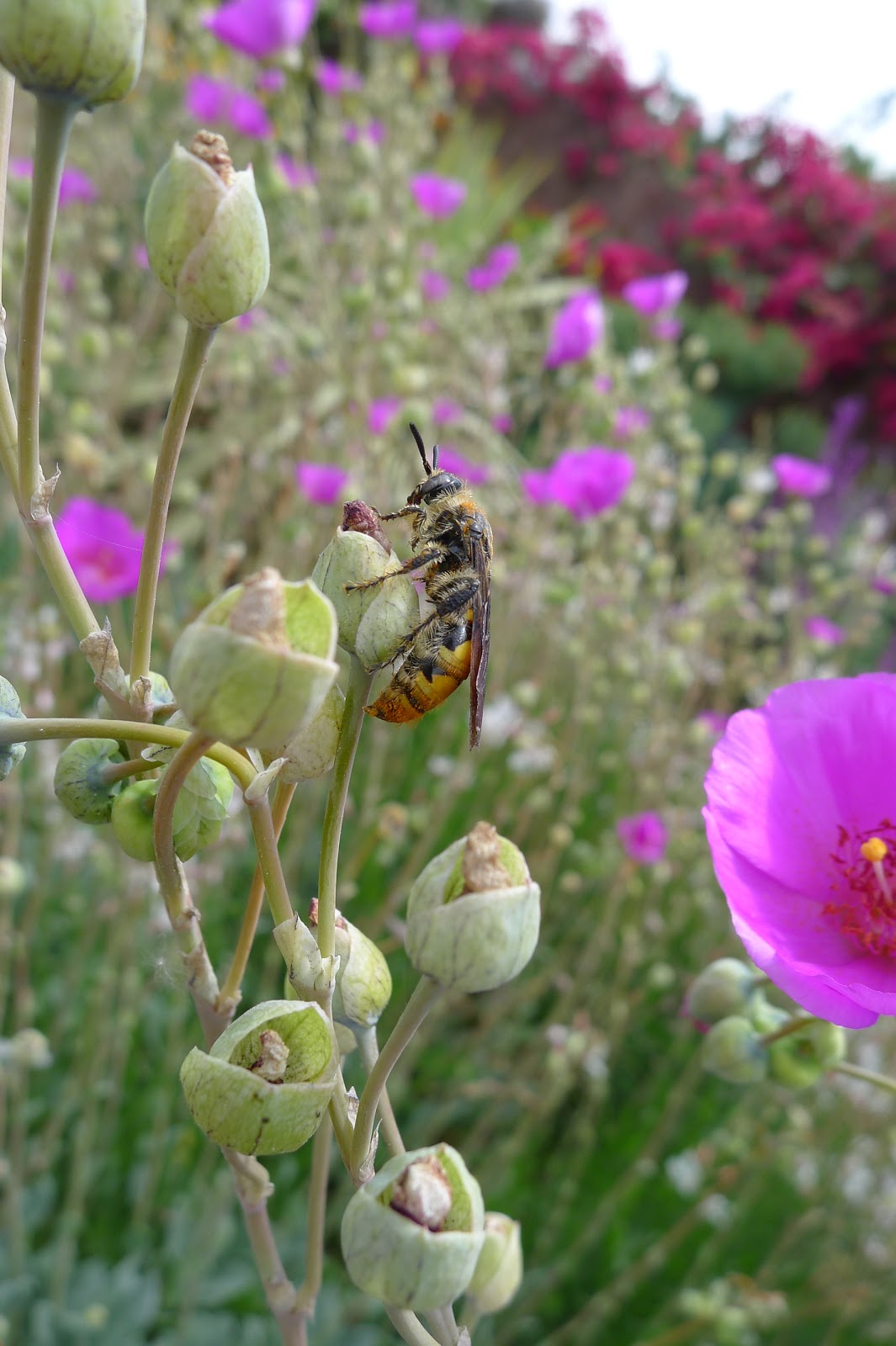
Isn't this a beautiful beast?  Finally got some good shots of the Sand Wasp in the old garden.  Click on image to get larger view of those eyes and perfect chevron-esque stripes.  More info on these native pollinators here: What's That Bug?

Longstem Buckwheat


My favorite California native, longstem buckwheat or Eriogonum elongatum, is blooming in the old garden.  I stopped by yesterday to do some maintenance, and am glad I brought my camera.  Large swaths of silvery gray stems draped over the other plants in the garden, which looked a little worse for wear after a very hot week.  It's the end of the summer, the hottest and driest time of the year, and this buckwheat was thriving while many of the other plants were dormant. Like most other buckwheats, this one has small white puff balls of flowers, with faint pink tinges.  As autumn gets closer and these dry out, they turn a lovely rust color. 

Not surprisingly, the buckwheats (this elongatum and also the grande rubescens) were the most popular with the bugs.  These guys were hopping with bees and moths of all sorts, creating a very healthy hum.

These are seasonally available from Theodore Payne.  More info from Calflora as well as from this charming video.

8.11.2011

Native Pollinators


I've been into bees for awhile, but only just started to understand how many different kinds there are.  I knew my old garden, pictured above, was a healthy living thing when I could feel it buzzing with bug life.  Upon closer inspection, I noticed the buzzing-ones were all sorts of bees.  They'd be huge, like the Valley Carpenter Bee, or tiny, like a Sweat Bee.  I was even seeing some beautiful zebra striped ones in black and white, which I believe are Plasterer Bees (I'm still learning).  They are all really difficult to get pictures of with a point-and-shoot, so my images are limited.  I do know that many of these are ground bees, whose little homes spot the garden like above.

These bees are not just flying stingers.  In fact, some don't even sting and it's the European Honey Bee that's the worst offender in terms of stings.  These native pollinators are extremely important for the plants and other animal life.  I understand the Honey Bee has had some issues in the past few years, but we should really encourage more of the native bees.   The best resource I've found for this is this book, Attracting Native Pollinators by the Xerces Society.  It really opened my eyes to the wonderful selection of helpful bugs. 


5.22.2011

Los Angeles Wildflowers


Eriogonum elongatum (longstem buckwheat) on Mt. Washington.  My favorite California native plant.  I stumbled upon this in an open field when I first moved here.  Little did I know then how important CA Natives would become to me.  I have since bought several from Theodore Payne that are thriving in my garden.  More info here: calflora.org


In the garden this May, building up to the bloom in late summer.